
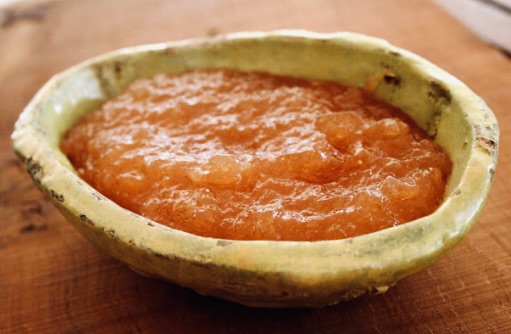

Quince Jam or Paste Sicilian Version: how the quince get in to the other world
Cotognata, or quince jam, is one of those desserts that belong to autumn — when the quince, a fruit now considered “ancient” (how curious that sounds), is ready to be picked but still impossible to eat raw.
Strong, resilient, and adaptable to many climates, it came to Sicily from far away — from Iran, Turkey, and perhaps already from the coasts of Greece.
It never really left this land, though: with the arrival of sugarcane, quince gained new life, becoming easier to preserve and more widely used by everyone.
Its story crosses the Mediterranean. The recipe traveled with Sephardic communities and, during the Aragonese rule, reached the island — where sunlight, patience, and Sicilian women’s hands turned it into a small masterpiece.
We share this sweet heritage with Portugal, other parts of Italy, the Middle East, and Latin America, where it’s known as dulce de membrillo.
The first evidence of quince preserves dates back to Roman times: Columella, in his De re rustica, already wrote about fruits preserved in honey — the only way, back then, to make such a stubborn and inedible fruit pleasant.
It’s fascinating that quince is also tied to the birth of a new word: marmalade.
Yes — the word marmellata comes from the Portuguese marmelo, which means quince.
Originally, throughout Europe, “marmalade” meant cotognata. Only later did the word extend to other fruits, like oranges (interestingly, in English, marmalade still specifically means orange jam).
So, in a way, for much of the Mediterranean, cotognata is the mother of all marmalades — certainly one of the very first.
A seasonal ritual, as always…
Once upon a time in Sicily, autumn was the season of preserves and slow preparations. (and thanks God still is somewhere)
Fires were lit, ripe fruits were cut, and the sun did the rest: it was the art of preserving life for the colder months ahead, because even if short, we have winter here.
That was when people made mostata/mustata and cotognata, which then brought sweetness and colorful energy to homes until Christmas.
But cotognata was never just a dessert — it was also a gift, a sign of love and remembrance.
On November 2nd, the Day of the Dead, families prepared cannistra, baskets filled with sweets and fruit — ossa di morto(bone-shaped cookies), pupi di zucchero, dried figs, pomegranates — and, of course, shiny cubes of cotognata.
Children would find them in the morning, said to be “sent by the dead,” as small gifts from the world of memory.
Until recently, the Feast of the Dead was the true Christmas for Sicilians, in the sense that the giving of gifts to children was more focused on this holiday than on Christmas Day. In this, we could see a parallel with the celebrations in Mexico, the result of cultures that are similar in their desire to exorcise and remember, keeping it alive, the connection between the two worlds.
Time, sunlight, and molds
Making cotognata isn’t difficult, but it requires patience.
The quinces are cleaned, cut, and cooked slowly with sugar and a bit of lemon.
Here at Three Farms Island, in the soft version, we also add a pinch of cinnamon, a breath of ginger — and sometimes even a few cloves — spices that embrace the fruit and warm it gently, like the November sun.
For the traditional Sicilian version (the firm one), the purée is poured into terracotta molds and left to dry slowly in the sun or open air until it becomes firm and shiny like amber.
That moment, when light rests on the sweet and transforms it, is pure rural magic: living matter changing naturally, not forced, only accompanied.
The terracotta molds
Every family once had their own molds.
As often happens, food was also a carrier of identity, a way of expressing belonging through form and symbol — sometimes religious, sometimes simply local.
Because Sicily is surrounded by the sea, it’s common to find fish-shaped molds in old markets, among others shaped like flowers or fruit.
Each tells a story — of home, of devotion, of everyday art.
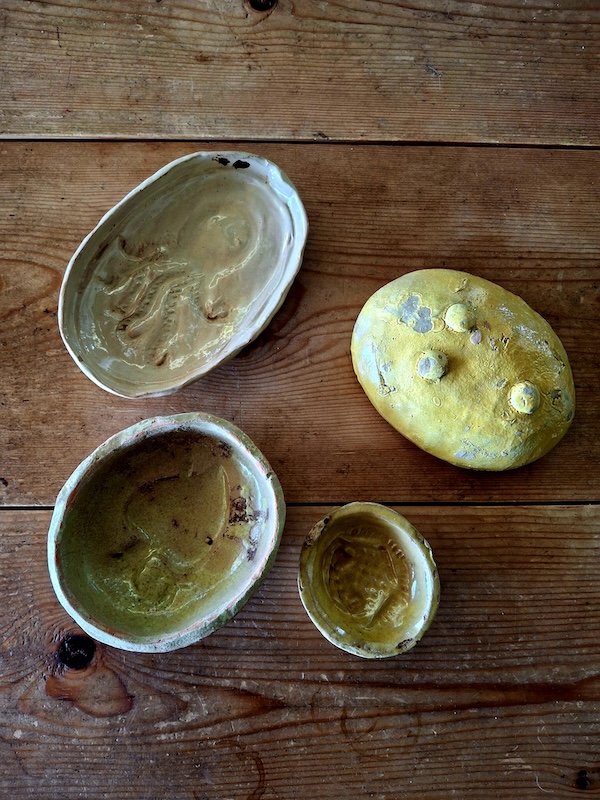
In these 4 terracotta molds of ours, from Annarella’s great-grandmother (and perhaps a generation before) until now we can see an octopus, often the sea for our area was a sign of abundance and therefore good fortune, and the religious symbol of the sacred heart of Jesus, in the little one we were unable to understand well... what is it in your opinion?Food as a bridge – and new connections
While here in Sicily some of these rituals are kept alive partly thanks to cultural tourism, it’s beautiful to see how the revival of forgotten fruits and recipes continues elsewhere, taking new shapes and meanings.
We love to mention the work of our friends at the Coolinary Breeding Network and their wonderful events, including the Quince Fest, which took place on December 2nd in Portland — a celebration of the quince, its history, and its power to bring people together.
It’s moving to think that the same fruit once used in Sicilian kitchens to remember the departed now inspires communities on the other side of the ocean — a reminder that food, memory, and ritual are truly universal languages.
The preparation
To make the jarred version of cotognata, start by cleaning and cutting the quinces, then soak them in a little lemon juice. Remove only the cores, and cook the fruit together with sugar — we love to add a touch of cinnamon and ginger for a warm, fragrant note. Once soft, blend everything until smooth and pour it into jars while still hot.
For the traditional hard Sicilian cotognata, instead, the whole fruit – always removes the inside – is cooked and then passed through a food mill. The smooth purée is combined with sugar and poured into molds to dry slowly in the sun or in a warm, airy space.
What makes Sicilian cotognata truly special is also the mold in which it is left to dry: beautifully carved forms decorated with flowers, fruits, or symbols of the island. This craft has been part of Sicilian culinary history for centuries, and many of these molds can still be found in old markets across the island. They are not only functional but also small pieces of art — a living memory of Sicilian tradition and its deep connection between food, beauty, and heritage.