
From tiny wild olives to larger cultivated varieties, Sicily’s olive trees tell a story of nature, human knowledge, and thousands of years of agricultural history.
What Can a Handful of Olives Tell Us About Sicily?
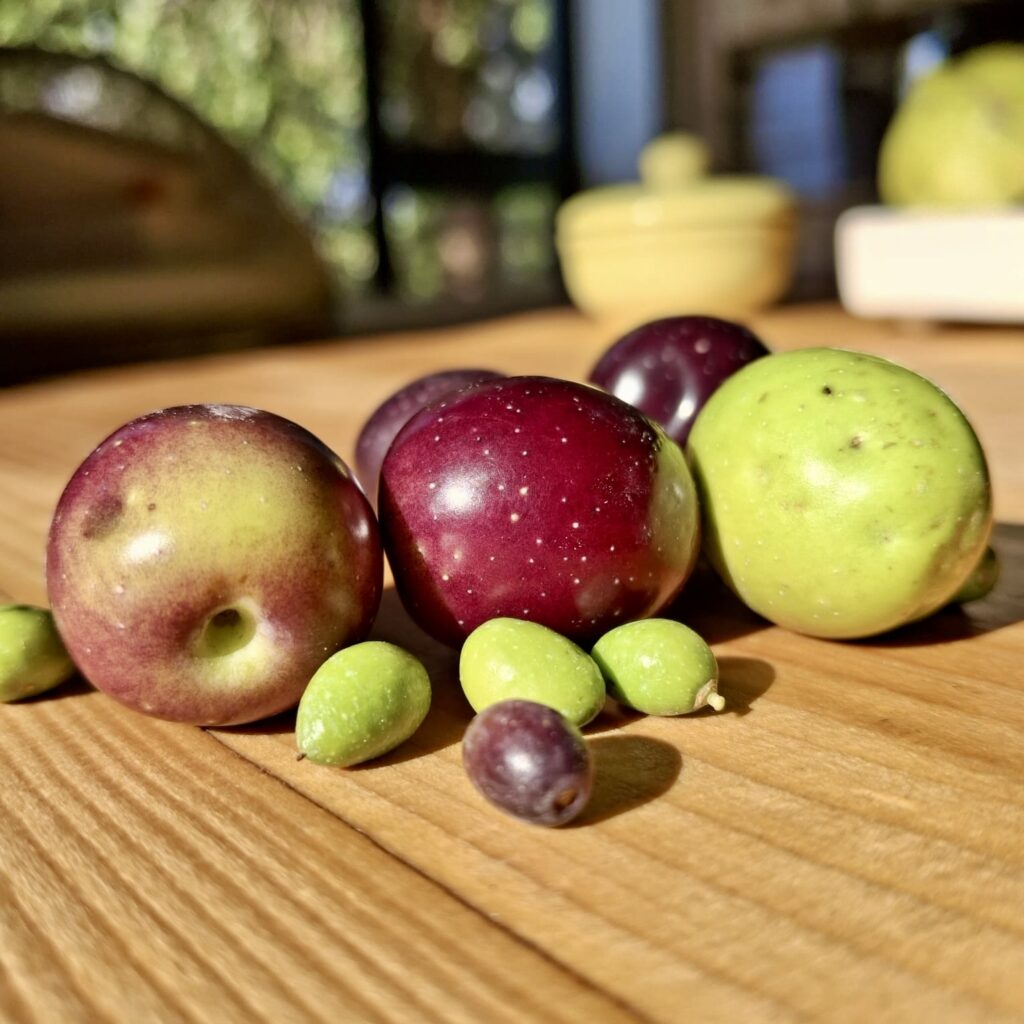
Take a look at these olives on our farm table.
Some are incredibly small, while others are several times larger.
They all belong to the same species, Olea europaea, yet their differences are remarkable.
The smallest fruits come from an olive tree growing wild, while the larger ones belong to one of the traditional cultivated varieties we have found here at Three Farms Island, our family-run regenerative farm in southeastern Sicily, near Noto.
We didn’t plant these particular trees. They were already growing here, some long before we began taking care of this land.
And they are far from being the only varieties we have discovered.
Walking through our farm, we often notice how different olive trees can be, even when they grow relatively close to one another.
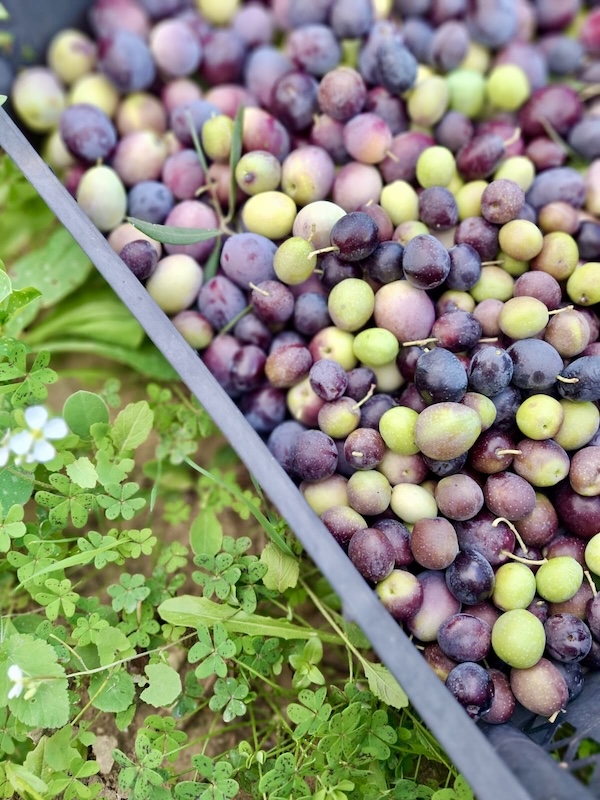
Some produce small fruits, others much larger ones. Their shapes, growth habits, and responses to the surrounding environment can also be surprisingly different.
Even among the wild-growing olive trees, we find variations worth observing.
This diversity is one of the most fascinating parts of living and farming in Sicily.
But how did these differences develop?
What Is the Difference Between Wild and Cultivated Olive Trees?
Wild olive trees, commonly known as oleasters, are the wild relatives of the cultivated Mediterranean olive.
They generally produce much smaller fruits, with less flesh and a lower oil content than the varieties selected for agriculture.
Cultivated olive trees, on the other hand, are the result of a long process of domestication and selection.
For thousands of years, farmers have identified and propagated trees with characteristics they considered valuable: larger fruits, suitable oil content, desirable flavours, reliable production, or the ability to grow in particular environments.
Over generations, these choices contributed to the diversity of cultivated olives we know today.
The relationship between wild and cultivated olives is complex.
Natural cross-pollination can create new genetic combinations, while grafting and propagation by cuttings allow farmers to preserve particular varieties without changing their genetic identity through the graft itself.
There are also olive trees growing spontaneously that descend from cultivated varieties or crosses between cultivated and wild populations.
For this reason, appearance alone is not always enough to establish whether a particular tree is genetically wild.
What we can easily observe, however, is the remarkable variation that exists within this single Mediterranean species.
Sicily: Thousands of Years of Olive Cultivation
The history of the olive tree extends far beyond recorded history.
Archaeological research suggests that olive cultivation was already taking place in the eastern Mediterranean around 7,000 years ago.
Over the following millennia, cultivation practices, plants, and agricultural knowledge spread through the Mediterranean world.
Sicily has its own fascinating evidence of this ancient relationship.
In 2018, researchers identified chemical residues consistent with olive oil in prehistoric pottery from Castelluccio, near Noto, dating to the end of the third and beginning of the second millennium BCE.
This discovery is particularly meaningful to us because Castelluccio is located in the same part of Sicily where we live and farm.
It provides evidence for the presence of olive oil in the region around 4,000 years ago, although it does not establish exactly where that oil was produced.
More recently, a scientific study published in 2025 examined ancient pollen records from the Messina Strait area.
The researchers found evidence suggesting that human activity was already influencing the spread of olive trees in eastern Sicily approximately 3,700 years ago, during the Bronze Age.
These discoveries do not establish an exact date for the beginning of olive cultivation in Sicily.
Instead, they reveal how ancient the relationship between this island, its people, and olive trees already was.
And there may still be much more to discover.
An Island Shaped by People, Plants, and Cultural Exchanges
Sicily has always been a meeting place in the Mediterranean.
Different civilizations arrived on its shores, bringing agricultural knowledge, traditions, and plants from other regions.
The island’s agricultural landscape developed through this long history of movement and exchange.
Olive varieties travelled with people. Natural crossings occurred between trees, while generations of farmers observed, selected, grafted, and preserved plants suited to their needs.
Different environments and different agricultural traditions encouraged the conservation of different characteristics.
The result is a rich heritage of olive varieties, each with its own history and particular qualities.
Some are widely cultivated today. Others survive in smaller areas, old groves, or among trees that have remained part of traditional rural landscapes for generations.
One example we have encountered here at Three Farms Island is the rare Leucocarpa, an olive variety known for its unusual white fruits.
We shared the story of finding this remarkable tree in our article The White Olives Still Exist in Sicily.
It is another small reminder of how much agricultural diversity can still be found on this island.
Why Does Olive Biodiversity Matter?
Every olive variety represents a particular combination of genetic characteristics.
Some may be better suited to particular soils or climatic conditions. Others may offer different fruit characteristics, growth habits, or responses to environmental stresses.
This diversity represents an important resource for agriculture, especially as Mediterranean environments face increasing climatic pressures.
But agricultural biodiversity is not only about genetics.
It also includes the knowledge accumulated by farmers over generations: understanding which trees grow well in certain places, how to propagate them, and how to manage them through changing seasons.
When a local variety disappears, part of this agricultural heritage can disappear with it.
Preserving biodiversity therefore means paying attention not only to the plants themselves, but also to the relationships between people, farming practices, and the environments in which those plants grow.
Biodiversity at Three Farms Island
Here at Three Farms Island, we are fortunate to work in a landscape where many different plants and old trees were already present before us.
Our approach to regenerative agriculture begins with observing what grows here and trying to understand why.
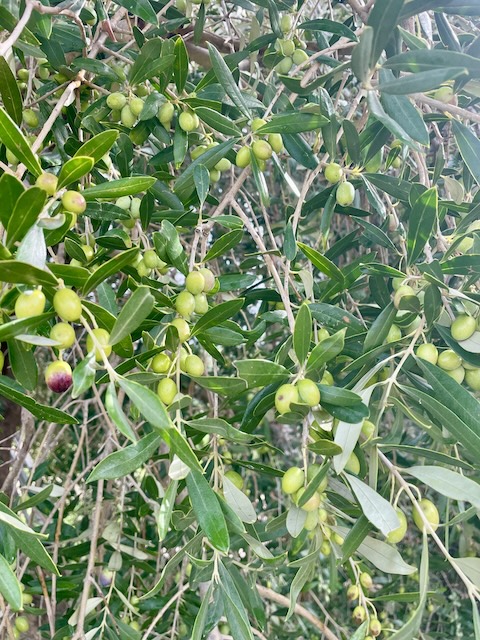
We find olive trees in different parts of the farm, growing alongside carob trees, almonds, spontaneous vegetation, and other plants that form part of the local ecosystem.
Different soils, levels of exposure, and growing conditions contribute to the diversity we observe.
Rather than trying to make every part of the farm behave in the same way, we believe it is important to understand these differences and work with them.
That does not mean we always know the answers.
Sometimes it takes years of observation to understand why a particular tree grows well in one place or behaves differently in another.
And sometimes an unexpected discovery, like a handful of unusually small olives, gives us a reason to ask new questions.
The old olive trees growing on our land are part of an agricultural history that began long before us.
Our responsibility is to learn from them, take care of the diversity we have inherited, and allow this living heritage to continue.
Because the story of Sicily’s olive trees is not only found in archaeological sites, scientific research, or ancient books.
Sometimes, it is right there on a small farm table.
A handful of olives, each carrying a little piece of a much bigger story.
Fabio & Annarella
Three Farms Island, Sicily
Scientific references
- The History of Olive Cultivation in the Southern Levant — Frontiers in Plant Science, 2023.
- On the Origins and Domestication of the Olive: A Review and Perspectives — Annals of Botany, 2018.
- Identification of Olive Oil in Early Bronze Age Pottery from Castelluccio — Analytical Methods, 2018.
- The Human-Driven Ecological Success of Olive Trees over the Last 3700 Years in the Central Mediterranean — Quaternary Science Reviews, 2025.