
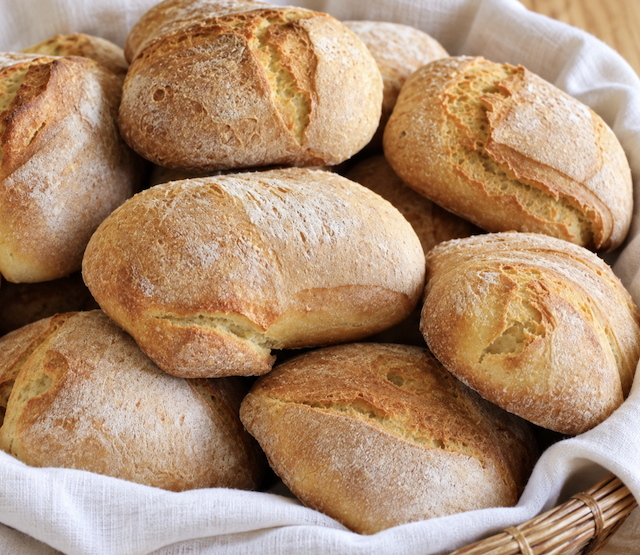

In Sicily, and across many parts of Southern Italy, pagnotta is a familiar name for a rustic loaf of bread. It comes in different shapes and sizes, and every area — often every household — has its own way of making it.
Sicily has a long relationship with wheat and with the preservation of traditional Sicilian grains, many of which are still cultivated and rediscovered today.
At our farm, we make smaller pagnotte, or pagnottine, with a soft crumb and a rustic golden crust. Our dough is quite highly hydrated and is made entirely with durum wheat flour, the flour traditionally known in Italy as semola rimacinata di grano duro.
This is an important distinction if you are making the recipe outside Italy.
What is semola rimacinata?
Semola rimacinata di grano duro is a very finely milled flour made from durum wheat.
You may sometimes find it translated as remilled durum wheat semolina, but the word semolina can be misleading outside Italy. The flour we use for these pagnotte is much finer than the coarse semolina commonly sold in many international supermarkets.
When shopping outside Italy, look for:
fine durum wheat flour
or
remilled durum wheat semolina
The texture should be fine and flour-like rather than coarse or granular.
This finely milled durum wheat flour gives the bread its characteristic warm golden colour and contributes to the flavour and texture of the loaf.
Why are these pagnotte so soft?
The dough contains 700 g of water for every 1,000 g of flour, giving it approximately 70% hydration.
This makes the dough noticeably soft and slightly more delicate to handle than a lower-hydration bread dough.
Rather than adding extra flour until the dough becomes firm, we allow the dough to remain soft. During shaping, the pagnotte are handled gently, bringing the dough inward without pressing out all the air developed during the first fermentation.
The result is a rustic bread that remains pleasantly soft inside.
Soft Durum Wheat Pagnotte Recipe
Makes: 4–5 small loaves
First rise: approximately 3–4 hours
Second rise: approximately 40–60 minutes
Baking time: approximately 30–35 minutes
Oven temperature: 220°C / 425°F, then 200°C / 390°F
Ingredients
- 1 kg / 35 oz fine durum wheat flour (semola rimacinata di grano duro)
- 700 ml / approximately 3 US cups lukewarm water
- 12 g salt
- 10 g / 0.35 oz fresh yeast
Alternative fermentation
The same type of bread can also be prepared using 100–150 g of active sourdough starter instead of fresh yeast.
Both methods require different fermentation times, so we prefer to treat them as variations rather than simply replacing the yeast gram for gram.
How to Make Soft Durum Wheat Pagnotte
1. Sift the flour
Sift the durum wheat flour into the bowl of a stand mixer or directly onto a clean work surface if kneading by hand.
2. Mix the dough
Dissolve the fresh yeast in a small quantity of the lukewarm water.
Add it to the flour together with the salt, then gradually add the remaining lukewarm water as you begin mixing.
Knead by hand or with a stand mixer until the dough becomes smooth and homogeneous.
The dough will be very soft. This is intentional: with approximately 70% hydration, it should not feel like a firm bread dough.
Avoid adding large amounts of extra flour simply to make it easier to handle.
3. First fermentation
Cover the dough and leave it to rise until approximately doubled in volume.
This usually takes 3–4 hours, depending on the temperature of the room.
If your kitchen is cool, you can place the covered dough inside a switched-off oven with the oven light on, creating a warm and protected environment for fermentation.
4. Divide and shape the pagnotte
Lightly flour the work surface and gently turn out the risen dough.
Divide it into 4–5 pieces.
Shape each pagnotta carefully. Bring the outer edges of the dough inward toward the centre, gently closing and shaping the loaf without pressing down heavily.
Try to preserve as much as possible of the air created during the first rise.
5. Second fermentation
Cover the shaped pagnotte and leave them to rise again for approximately 40–60 minutes.
Meanwhile, begin heating the oven.
6. Preheat the oven — and the trays
For a conventional home oven, preheat to 220°C / 425°F.
Heat the baking trays inside the oven as it comes to temperature. Starting the bread on a hot surface helps give the loaves an immediate burst of heat when they enter the oven.
The pagnotte in our photographs were baked directly on stone in our wood-fired oven, at approximately 200°C / 390°F.
7. Score the bread
Only immediately before baking, make a few cuts across the surface of each loaf using a very sharp knife or bread lame.
Do this gently so that you do not deflate the dough.
8. Bake the pagnotte
Carefully place the loaves onto the hot baking trays.
Bake at 220°C / 425°F for 10 minutes.
Then reduce the temperature to 200°C / 390°F and continue baking for another 20–25 minutes.
The exact baking time will depend on the size of your pagnotte.
They are ready when they are well risen and evenly golden on the outside.
9. Leave them to cool
Remove the pagnotte from the oven and allow them to cool before cutting.
The crumb continues to settle as the bread cools, so resist cutting into the loaves immediately after baking.
Baking These Pagnotte in a Wood-Fired Oven
At the farm, we often bake these loaves directly on the stone floor of our wood-fired oven.
The pagnotte shown in these photographs were baked at approximately 200°C / 390°F.
A wood-fired oven behaves differently from a domestic electric oven: the hot stone transfers heat directly to the base of the bread while the retained heat of the oven surrounds the loaf.
At home, preheating your baking trays — or using a baking stone if you have one — helps reproduce part of this effect.
Can You Make These Pagnotte with Sourdough Starter?
Yes. Of course!
Instead of fresh yeast, we always prepare them with 100–150 g of active sourdough starter.
However, sourdough fermentation should not be treated simply as a direct substitution for fresh yeast. The activity and hydration of the starter, room temperature and fermentation time will all influence the dough.
For that reason, expect the rising times to be longer and use the appearance and development of the dough, rather than the clock alone, as your guide.
Durum Wheat Flour vs Semolina: Are They the Same?
They come from the same grain — durum wheat — but they are not necessarily the same product for baking purposes.
Coarse semolina has a noticeably granular texture.
The semola rimacinata used for these pagnotte has been milled much more finely. For an international cook, fine durum wheat flour is therefore often the clearest description.
If a package says semola rimacinata di grano duro, that is exactly the type of flour we use.
Can I Make This Bread with Coarse Semolina?
We would not recommend replacing the fine durum wheat flour with the same quantity of coarse semolina and expecting the same result.
The different particle size changes the way the flour absorbs water and how the dough develops.
For this recipe, look specifically for a finely milled durum wheat product.
Why Is Durum Wheat Bread Golden?
Durum wheat naturally gives the dough a warm yellow-golden colour, which remains visible in both the crumb and crust after baking.
It is one of the immediately recognizable characteristics of breads made predominantly with durum wheat flour.
For us, these pagnotte are not about reproducing a perfectly identical loaf every time.
And then yes, Olive Oil, salt or a slice of pecorino, a bit of chilly and Origano make the traditional way to enjoy for us.
Flour, temperature, fermentation and the heat of the oven all affect the dough. Learning to recognize when it has risen enough, how softly it needs to be handled and when the crust has reached the right colour is part of making bread.
The recipe gives you the proportions.