
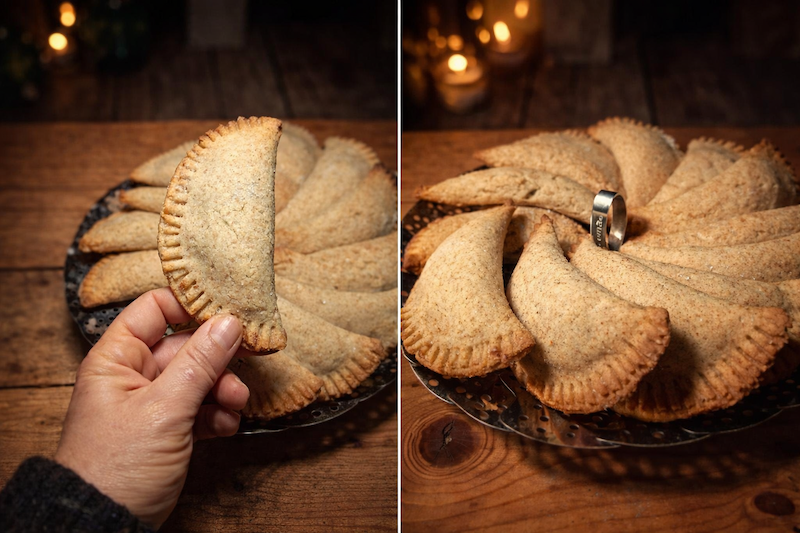

Cassatelle di Agira are one of Sicily’s most iconic traditional desserts — and they perfectly show what happens when a single recipe becomes deeply tied to a place.
This is something you see often in Sicily, and more broadly in southern Italy: food doesn’t just belong to the kitchen, it belongs to the land, to memory, and to identity. Over time, many recipes change and evolve, but the ones that become truly identitarian tend to resist change. They stay almost stubbornly the same. That’s exactly the kind of food story we love to look for.
Cassatelle di Agira come from the heart of the island, in the small town of Agira. Today it may seem quiet, but historically it was an important center, especially during the Norman and Swabian periods — a role still visible in the remains of the castle that dominates the town from the top of the hill.
The recipe itself was born from a humble rural tradition and strongly influenced by Arab culinary culture. Like many important Sicilian sweets, it was preserved and refined within the monastery of Agira. Monasteries were often true centers of culinary experimentation, where recipes were perfected with care, precision, and a deep understanding of ingredients.
What really makes Cassatelle di Agira unique is their ability to last. Unlike most other Sicilian cassatelle — especially the fried versions you’ll find across the island (and in our other recipes, linked here) — these cassatelle are baked, not fried, and were specifically designed to be stored.
This wasn’t just practical, it was essential. In other parts of Sicily, like Ustica, there was even a tradition of preparing a cassatella at Christmas and keeping it until Easter. To this day, in the local dialect, people say “you’re like an Easter cassatella” — meaning a small treasure, carefully preserved and rediscovered with joy.
A key role in this long shelf life is played by the filling, and especially by its most surprising ingredient: toasted chickpea flour. Lightly toasted, it releases warm, nutty aromas reminiscent of hazelnuts. Combined with almonds, cocoa, cinnamon, and lemon zest, it gives these cassatelle their unmistakable depth and character.
Ingredients
Shortcrust Pastry
- 550 g all-purpose flour (about 4 ⅓ cups)
- 180 g sugar (about ¾ cup + 2 tbsp)
- 200 g butter or lard (about 7 oz / 1¾ sticks)
- 1 egg + 1 egg yolk
- 50 g warm water (about 3 tbsp + 1 tsp)
Filling
- 300 g peeled almonds (about 3 cups)
- 180 g cane sugar (about ¾ cup + 2 tbsp)
- 450 ml water (about 1¾ cups)
- 40 g chickpea flour (about 5 tbsp)
- 50 g unsweetened cocoa (about ½ cup + 2 tbsp)
- Zest of 2 lemons
- 1 tsp ground cinnamon
To Garnish
- Powdered sugar, to taste
- 1 tsp ground cinnamon
Method
1. Prepare the shortcrust pastry
In a large bowl, mix the flour and sugar. Add the cold butter (or lard), cut into small pieces, and rub it into the flour with your fingertips until the mixture resembles coarse crumbs.
Add the whole egg and the egg yolk, then gradually incorporate the warm water. Mix until a smooth, compact dough forms.
Shape into a disc, wrap, and refrigerate for at least 30 minutes.
2. Prepare the filling
Finely grind the peeled almonds.
In a saucepan, bring the water and cane sugar to a gentle boil. Lower the heat and add the ground almonds, stirring continuously.
In a separate pan, lightly toast the chickpea flour over low heat until fragrant and nutty. Add it to the almond mixture together with the cocoa, lemon zest, and cinnamon.
Cook over low heat, stirring constantly, until the mixture thickens into a dense, smooth paste.
Remove from the heat and allow it to cool completely.
3. Shape the cassatelle
Roll out the chilled pastry on a lightly floured surface to a thickness of about 2–3 mm.
Cut circles approximately 10–12 cm in diameter.
Place a spoonful of filling in the center of each circle. Fold into a half-moon shape, seal the edges well, and crimp with a fork. Like a Raviolo
4. Bake
Arrange the cassatelle on a baking tray lined with parchment paper.
Bake in a preheated oven at 180°C / 350°F for 20–25 minutes, until lightly golden. They should remain pale rather than deeply browned.
5. Garnish and store
Let the cassatelle cool completely.
They keep well for several days, which is exactly why they were traditionally prepared in advance — both in rural households and in monastery kitchens.