
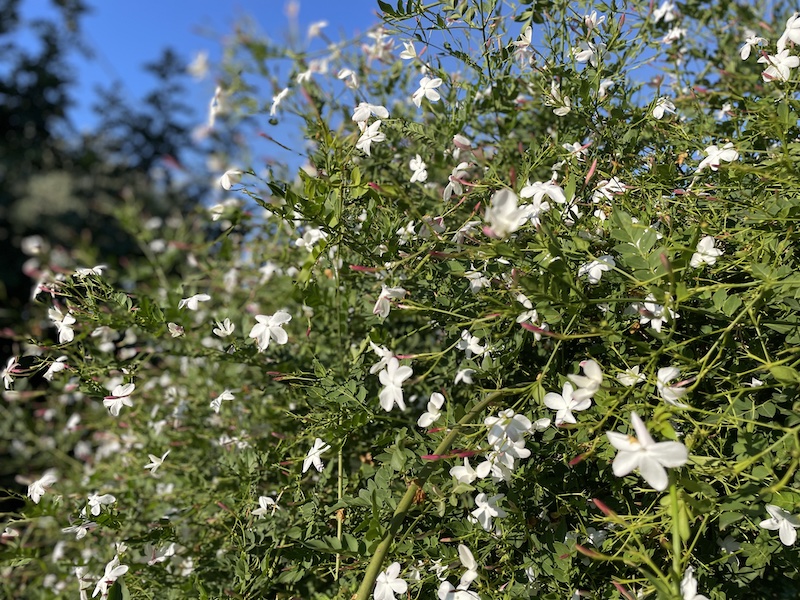

Jasmine is much more than a scented flower: in Sicily it is a piece of history, landscape, and collective memory, also piece of identity.
It is the fragrance of summer evenings, long evenings…one of the most beloved scents of all.
I remember my grandfather Salvatore telling me that his father used to pick a few blossoms and leave them inside the wardrobe so his shirts would always smell wonderful.
In this article, we’ll talk about Sicilian jasmine or Spanish (it’s the same) (Jasminum grandiflorum) and arrive at a dessert that is more of an experience, a playful experiment. Having access to fresh blossoms allows us to create a jasmine pudding made entirely from infusion — a 100% jasmine pudding, or Jasmine pudding, or Jasmin Biancomangiare a sweet treat that truly feels like “eating a fragrance.”
A brief history of Sicilian Jasmine
It was introduced to the island and in south of Spain by the Arabs between the 9th and 11th centuries — one of the greatest culinary and botanical revolutions in all of Europe.
Since then, jasmine has become part of the Sicilian landscape and imagination:
-
decorating courtyards, balconies, and pergolas
-
welcoming guests at the doorstep with its evening fragrance
-
accompanying religious festivals and folk traditions
-
symbolising love, good fortune, and rebirth in legends and the language of flowers
From gelsominaie workers to luxury perfumes
For decades, Sicily was a true open-air “perfume factory.”
Between the 1930s and 1960s, vast jasmine fields stretched across areas such as the Piana di Milazzo and the zones of Ispica, Avola, and Noto.
At the time, Sicily’s flowers were an important source of income for many families — not only jasmine but also bitter orange blossoms. Everything was harvested here, then sold (and resold) elsewhere to be processed. From these extracts, perfumes and scented products were produced and eventually exported worldwide, thanks to their long shelf life.
The flowers were hand-picked at night, when their aroma is strongest, by teams of women known as gelsominaie.
It was an intensive production system for that era — not particularly harmful to the soil, but certainly hard on the people who worked there. The women often worked barefoot, with high humidity maintained to encourage the plants to produce more. Children often followed their mothers into the fields, picking whatever was left. I had the chance to speak with some elderly people who shared these memories with me — fragrant fragments of childhood mixed with the reality of hard labour from a very young age.
The closed buds were destined for the extraction of a waxy substance called concreta, a precious base for the perfume industry. From it came fragrances renowned around the world, including those used by French luxury perfume houses. It was exhausting work, poorly paid, yet it became a symbol of women’s empowerment thanks to the labour struggles led by many of these workers.
It is not entirely true that Sicilians never rebelled. While the island has historically been open to new conquerors — a way of surviving, deeply rooted in its history — Sicilians did in fact rise up. One of the first organized strikes in Southern Italy and the first in Italy organized by only woman under the guide of Grazia Saporita in the 1946 took place in Milazzo, led by Sicilian women who fought and won better contracts.
History, however, was not kind to them. Soon after, the market changed: synthetic chemistry developed alternatives, demand collapsed, jasmine fields were uprooted, and the efforts of these women never translated into an easier or more dignified life.
Today, large industrial cultivations no longer exist, but jasmine lives on in gardens, agritourisms, small artisanal projects, and a handful of niche productions.
Jasmine in the kitchen: a fragrance you can eat
As often happens, a scent can attract us so much that we can’t help wanting to taste it (think of freshly roasted coffee).
This is also true for jasmine. Mediterranean cultures have long tried to capture that irresistible sweetness, leading to culinary traditions that still survive today — though now quite rare: Here in Sicily we use for
-
Gelo di mellone (watermelon pudding): a Palermo dessert served cold, flavoured with jasmine water and decorated with fresh flowers.
-
Jasmine granita (scursunera): once common between Palermo and Trapani, made from long infusions of jasmine blossoms in cold water and enriched with cinnamon.
-
Jasmine rosolio: a sweet liqueur made by macerating jasmine in alcohol, then blending it with sugar syrup.
We drew from the tradition that felt to us the most authentic — the purest expression of it. The Jasmine Biancomangiare
Jasmine Pudding or WhiteEat Jasmine
At Three Farms Island, like in all the Island, during November and December, jasmine reaches its peak, and the abundance of blossoms makes it almost impossible not to turn them into something delicious to try.
The jasmine we use is Sicilian or Spanish jasmine (Jasminum grandiflorum):
-
evergreen with grey-green leaves
-
white blossoms with an intoxicating sweet scent
-
blooming period: June to December/January
-
origins: Arabian Peninsula, Indian subcontinent, and East Africa
Be careful, not all jasmine are eatable.
How we prepare our jasmine pudding
Following Sicilian tradition, the recipe begins with jasmine water, traditional way to extract the taste.
1. Picking the flowers
-
Pick the blossoms at night or just before sunrise, when their perfume is most intense. This is a Must.
2. Making jasmine water
-
Place the flowers in a large glass or ceramic bowl.
-
Cover them with cold water (preferably non-chlorinated).
-
Let them infuse overnight: around 12/15 hours
-
Filter the next day, gently pressing the flowers to extract all the aromatic liquid.
This gives you a delicate jasmine water — the foundation of the whole recipe.
3. Turning the water into pudding
And that’s it, now you only need cornstarch and sugar. (of course in the past flour was used)
-
Pour the jasmine water into a small pot.
-
Whisk in the cornstarch while still cold to avoid lumps.
-
Add sugar to taste, making sure not to overpower the floral aroma.
-
Cook over low heat, stirring constantly, until the mixture thickens into a smooth cream.
-
Pour into moulds or individual cups.
4. Rest and serving
-
Let it cool to room temperature.
-
Then refrigerate and serve well chilled, perhaps decorated with a fresh jasmine blossom (untreated) or a twist of citrus peel.
The result? “Eating a fragrance”: an experience worth trying
If you visit us during the blooming season, you can experience firsthand what it truly means to “eat a fragrance.” Until then, you can bring a little piece of Sicily into your home by trying this pudding yourself: just a few ingredients, a bit of patience, and the flower will do the rest.
Here we’re sharing a very beautiful documentary video filmed in our area. I invite you to watch it, but it’s entirely in Sicilian/Italian. I’m putting a short summary here.
Overview
The documentary explores the history and memory of jasmine cultivation in southeastern Sicily (specifically in the areas of Avola and Ispica), an industry that flourished until the 1960s. Through interviews with former workers and the owners of the processing plants, the video reconstructs a bygone era of agricultural labor and perfume production.
Key Points:
-
The Harvest: Former pickers (some of whom started as young as 6 or 10 years old) recall the hardships of the job. The harvest took place from May to October/November. Workers had to wake up very early (around 2:00 or 4:00 AM) to pick the flowers while they were still fresh and wet with dew, as the heat would wither them and reduce their weight (and consequently the workers’ pay). Speed and the use of both hands were essential skills.
-
Living Conditions: Many workers came from neighboring towns and stayed at the farms for the entire week, sleeping in rough dormitories or barns on straw mattresses, sharing communal meals like soup in the evenings.
-
The Industrial Process: Luigi Lutri, the son of a former facility owner, explains the technical side. The fresh flowers were placed in copper vats with a solvent (petroleum ether) to extract the “concrete” (a waxy substance). This was later distilled under vacuum to create the “absolute,” the pure liquid essence used by prestigious French perfume houses (like Chanel and Lanvin).
-
The Decline: The industry collapsed in the late 1960s. This was due to the perfume market shifting towards synthetic scents and the multinational companies moving cultivation to developing countries (like India) to cut labor costs.
-
Legends and Traditions: A naturalist shares local folklore regarding the jasmine flower, including a legend about a girl named Jasmin transformed into a plant by the Sun God, and the flower’s traditional uses in Sicilian culture, such as in the dessert biancomangiare or as a beauty water for women.
The video ends with a nostalgic reenactment of the harvest, featuring young people in period clothing singing traditional songs, highlighting the cultural heritage of the “Gelsominu.”