
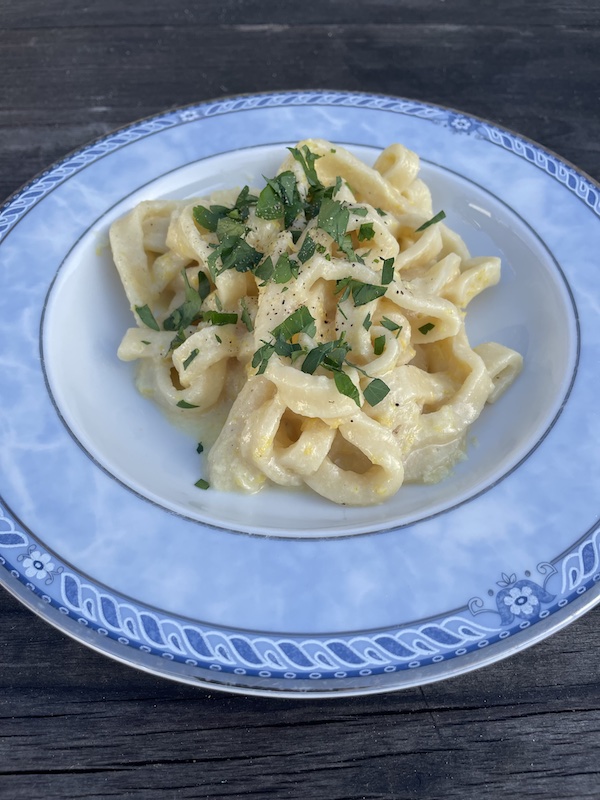

Lemon Pesto with Homemade Tagliolini — Our Winter Recipe from the Farm
This is the winter version of our lemon pasta. The cold months call for something richer — butter instead of olive oil, fresh pasta instead of dried, a pesto that clings to every strand and warms the room with lemon and Parmigiano. We make it on the farm when the lemons are heavy on the trees and the air outside is cold enough to keep the kitchen windows fogged.
The pasta here is rustic by intention. We do not chase uniformity — slightly uneven strands hold the sauce differently along their length, and the roughness of hand-cut semolina catches the butter in a way that a machine-perfect noodle does not. This is the Sicilian approach to fresh pasta: practical, tactile, shaped by what the hands can do with flour and water. A tradition, as it turns out, with very deep roots — dry pasta was born in Sicily, and the logic of durum wheat and simple technique has not changed much since.
It serves 4. It takes about 30 minutes. Everything you need is already in the kitchen.
Ingredients — Serves 4
For the fresh tagliolini
- 330 g (2 cups) durum wheat semolina flour (semola rimacinata di grano duro), plus extra for dusting
- 150 ml water, at room temperature
For the lemon pesto
- 2 organic lemons — zest of both, juice of 1½
- 40 g (3 tablespoons) butter, at room temperature
- 120 g Parmigiano Reggiano, freshly grated
- Salt and freshly ground black pepper
- Fresh flat-leaf parsley, for garnish
A note on the lemons: organic and unwaxed is not optional — you are using the zest, and the skin of a waxed lemon will give you a chemical note instead of the sharp, floral fragrance that makes this dish work. In Sicily lemons come from trees. If you are outside Sicily, find the most fragrant organic lemon you can.
A note on the flour: durum wheat semolina (semola rimacinata) gives the pasta a firm, slightly rough texture that holds the butter pesto well. Plain flour works in a pinch but gives a softer, less characteristic result.
How to Make the Lemon Pesto
Start with the pesto — it needs no cooking and improves as it sits at room temperature while you make the pasta.
In a bowl, work the butter with a fork until fully soft and pliable, with no cold lumps. Add the zest of both lemons and mix it in well. Add the juice of one and a half lemons and the grated Parmigiano. Mix until the pesto comes together — the texture should be slightly uneven, somewhere between a paste and scrambled eggs. That is correct.
Taste it. It should be sharp from the lemon and rich from the butter and cheese. Add black pepper. If it tastes very lemony, add a little more Parmigiano to balance. Set the bowl aside at room temperature — the cooked pasta will go directly into this bowl.
How to Make Fresh Tagliolini by Hand
-
Make the dough
Put the semolina flour into a bowl and make a well in the centre. Add the water gradually — start with half, work it in with your fingers, then add the rest. The dough will feel stiffer than egg pasta dough. This is correct: semolina absorbs water slowly and the dough needs a moment to come together.
Once it holds together, turn it onto a clean surface and knead for 8–10 minutes until the surface is smooth and the dough springs back slightly when pressed. Cover with the upturned bowl and rest for 10 minutes.
-
Roll the pasta
Divide the dough in two. Keep the second half covered while you work the first.
Using a rolling pin, roll the first piece into a rectangle approximately 2–3 mm thick. Work from the centre outward, rotating the dough as you go. Dust lightly with semolina if it sticks. The dough will resist at first — keep rolling, it relaxes.
-
Cut the tagliolini
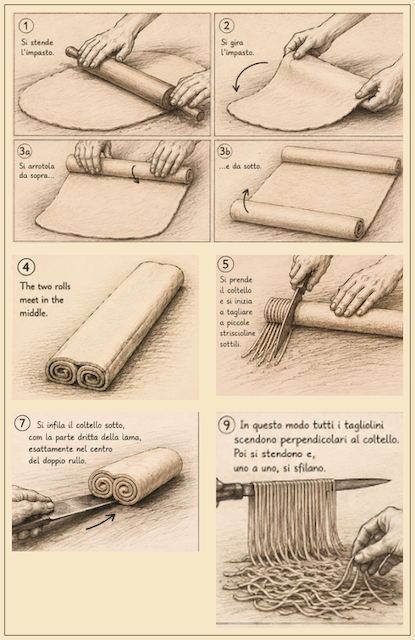
Dust the rolled sheet lightly with flour. Roll each short side of the rectangle toward the centre so they meet in the middle, forming a double scroll. Using a sharp knife, cut across the scroll widthwise into strips about 3 mm wide.
Slide the flat of the knife under the cut pasta at the centre where the two scrolls meet, then lift and rotate the knife from horizontal to vertical — the pasta unfurls into individual strands. Separate them gently with your fingers, dust with a little more semolina, and lay on a floured tray or parchment paper. Repeat with the second half of the dough.
-
Cook and dress
Bring a large pot of water to a rolling boil. Salt it generously. Drop in the tagliolini and cook for 2–3 minutes from the moment the pasta floats to the surface. Fresh semolina pasta cooks quickly — taste after 2 minutes.
Using a pasta spoon or tongs, transfer the tagliolini directly into the bowl with the lemon pesto, carrying a little of the cooking water with each spoonful. Toss vigorously until every strand is coated. If the pesto feels tight, add a spoonful of pasta cooking water and toss again — the starch binds the butter into a smooth, cohesive sauce.
-
Serve
Plate immediately. Garnish with a few leaves of fresh flat-leaf parsley — its clean bitterness balances the butter. Serve while hot.
A Variation: Spaghetti alla Chitarra
The tagliolini above are cut by hand with a knife — irregular, slightly thick in places, with a texture that varies from strand to strand. That irregularity is part of what we like about them.
If you want a more uniform result, or simply want to try a different shape, the same dough works beautifully through a pasta tool: either a stainless steel hand-cranked pasta machine, which rolls and cuts the sheet evenly, or a traditional chitarra — a wooden frame strung with parallel wires, across which you press the rolled sheet to produce squared spaghetti. The chitarra gives a rougher, more porous surface than a metal cutter, and that surface holds the lemon butter exceptionally well.
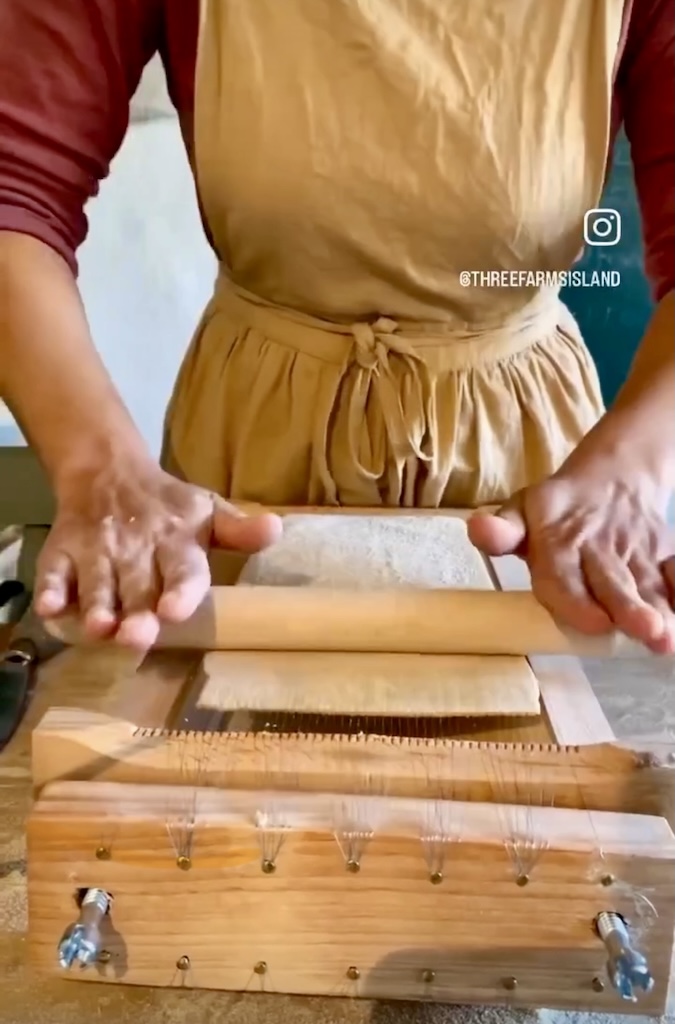
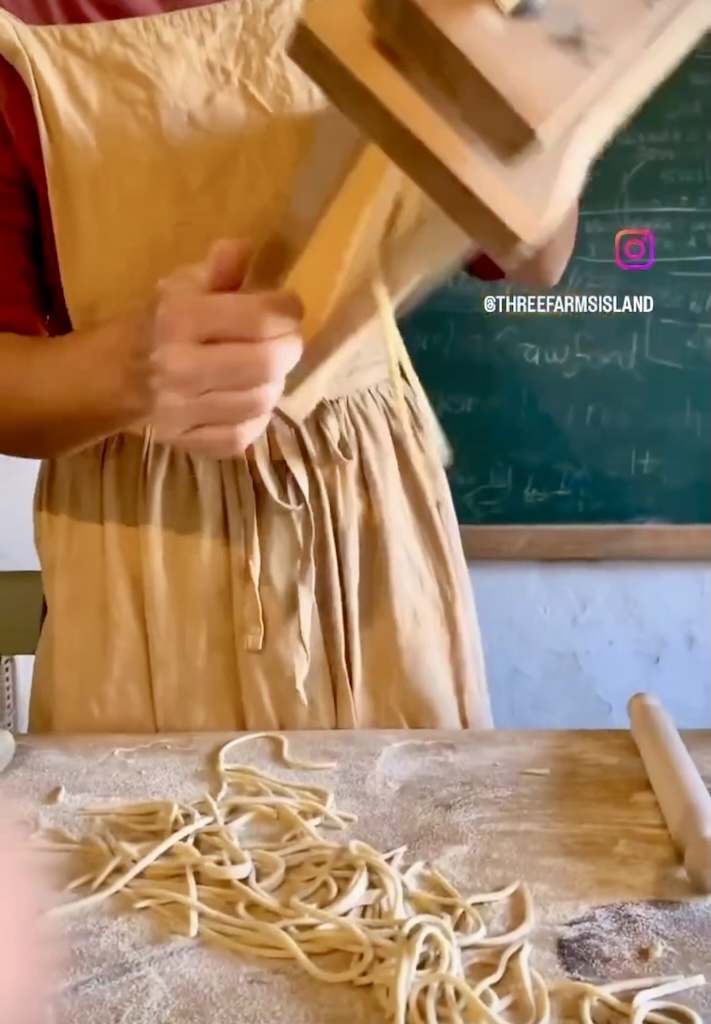
For the chitarra version, one adjustment helps: add one egg to the dough, reducing the water slightly (use 1 egg + 80 ml water instead of 150 ml water only). The egg gives the sheet more elasticity, which makes it easier to press through the strings without the dough tearing. The flavour and texture remain distinctly Sicilian — firmer and more substantial than northern egg pasta — but the strands come out cleaner and more consistent.
The rest of the recipe is identical: the lemon pesto, the cooking method, the finish with pasta water. Cooking time drops to about 90 seconds once the chitarra spaghetti float — they are thinner than the hand-cut tagliolini and cook faster.
Why Butter in Winter, Olive Oil in Summer
This recipe and our summer lemon pasta follow the same logic — lemon, good pasta, aged cheese — but arrive at different results because of one choice: the fat.
Butter is richer, rounder, and coats fresh pasta differently than olive oil. It suits a cold day and a slow lunch. Olive oil is lighter, more volatile, and carries the lemon fragrance outward rather than holding it close. It suits summer, dried pasta, and a table outside.
If you are cooking in the warmer months, or simply prefer a lighter dish, you will want to try our summer version: Annarella’s lemon spaghetti with olive oil and fresh basil pesto → Lemon Spaghetti by Annarella
Both recipes come from the same farm, the same lemons, the same conviction that what grows here shapes what ends up on the table.
A Note on This Recipe
The lemon pesto here works because of how butter behaves when hot pasta meets it: it melts into the starch of the cooking water and coats every strand in a single, coherent sauce. The lemon keeps it from feeling heavy. The Parmigiano gives it structure.
This is a recipe that rewards good ingredients and forgives imperfect technique. If the dough tears when you roll it, patch it and continue. If the pesto splits, add a spoonful of pasta water and toss harder. The only thing it does not forgive is a bad lemon.
The connection between this kind of cooking and Sicilian food history runs deeper than it might seem. Durum wheat pasta — made exactly this way, with semolina and water, dried or eaten fresh — is a Sicilian invention, documented in writing as early as 1154. We explore that history in our Substack, where we write about ingredients, territory and the culture that connects them: Ingredients Before Recipes on Substack
If you want to make this recipe with us — with semolina from the Sicilian interior and lemons from the garden — it is part of what we do in our hands-on cooking class on the farm. You can also join us live from home in an online Sicilian cooking class.
Frequently Asked Questions
What is lemon pesto made of?
In this recipe, lemon pesto is made from room-temperature butter, the zest of two organic lemons, lemon juice, and freshly grated Parmigiano Reggiano. There is no oil, no garlic, no basil — it is a butter-based sauce built specifically for fresh pasta in the cold months.
What is the difference between this recipe and Annarella’s lemon spaghetti?
The two recipes share the same base — Sicilian lemon and Parmigiano — but are distinct dishes suited to different seasons. This winter version uses homemade fresh tagliolini and a butter-based lemon pesto: richer, warmer, more suited to cold weather. Annarella’s summer version uses dried spaghetti and an olive oil and basil pesto: lighter, brighter, suited to warm months. You can find the summer recipe here → Lemon Spaghetti by Annarella
Do I need eggs to make fresh semolina pasta?
For the basic tagliolini, no — this dough uses only durum wheat semolina and water. Egg-free semolina pasta is the traditional approach in southern Italy and Sicily: firmer, slightly rougher, and well suited to sauces that need something to cling to.
If you are using a chitarra or a pasta machine to cut the dough into spaghetti alla chitarra, adding one egg (and reducing the water to 80 ml) gives the sheet more elasticity and makes it easier to press through the strings without tearing. The flavour and character remain distinctly Sicilian — the egg here is a technical aid, not a flavour change.
How many people does this recipe serve?
This recipe serves 4 people as a main course: 330 g of semolina flour for the pasta, 40 g of butter, 120 g of Parmigiano, and 2 lemons for the pesto.
Can I prepare the lemon pesto in advance?
Yes. The lemon pesto can be made up to 2 hours ahead and kept at room temperature, covered. Do not refrigerate it — cold butter will seize rather than coat the pasta. If it has been made more than 2 hours ahead, let it come fully back to room temperature before adding the hot pasta.
Can I use dried pasta instead of homemade tagliolini?
Yes. The lemon pesto works well with dried long pasta — spaghetti, linguine, or tagliatelle. Use slightly more pasta cooking water when dressing, as dried pasta releases more starch and the sauce will need a little more loosening to coat evenly.