Sicily produces 90% of Italy’s carob harvest. Yet the carob tree remains one of the least understood plants in the Mediterranean landscape — present everywhere in southeastern Sicily, ancient, deeply rooted in the territory’s geology and food culture, and almost entirely absent from contemporary food writing in English.
What Is the Carob Tree?
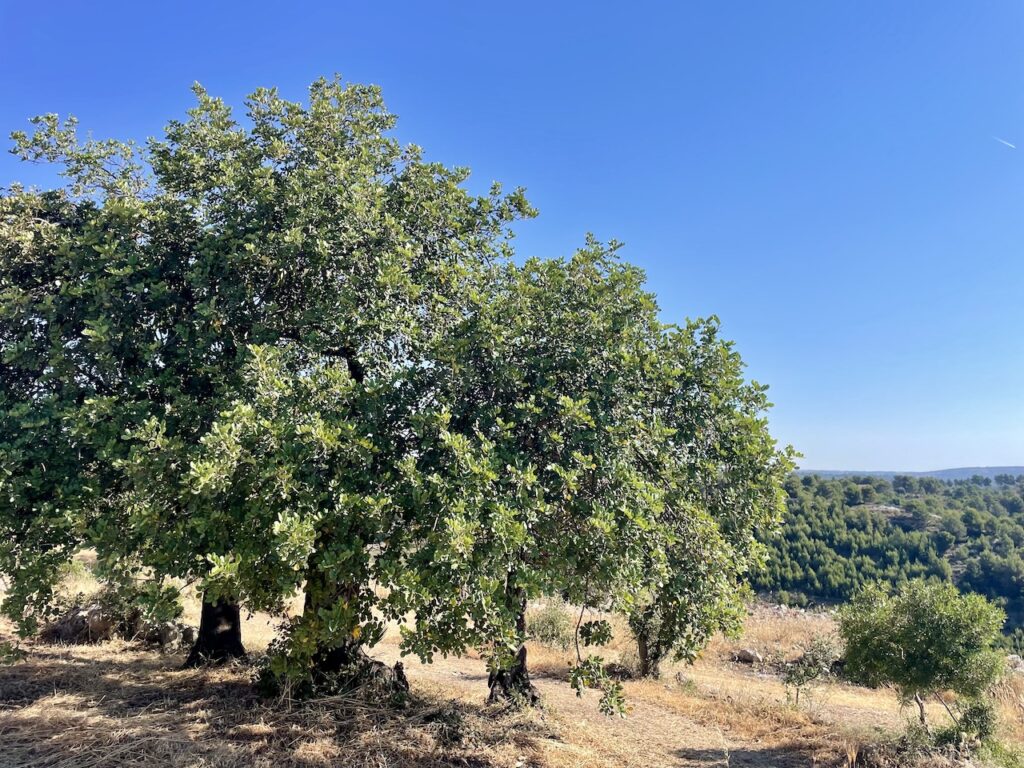
The carob (Ceratonia siliqua) is an evergreen tree native to the Mediterranean basin. Unlike most trees in the Sicilian countryside, it does not shed its leaves in summer. It stays green — intensely, stubbornly green — even when everything around it has yellowed under the July heat. It requires no irrigation, tolerates extreme drought, and produces fruit reliably for centuries. Specimens of 200, 300, even 400 years are not uncommon in the Val di Noto countryside.
Its distribution spans the entire Mediterranean perimeter: from the Maghreb to Turkey, from the Middle East to southern Spain. Wherever the climate is dry, the rock close to the surface, and the summer long and merciless, the carob finds a way to stay.
Carob and the Soil: A Tree That Creates What Others Require
Most trees need soil to grow. The carob builds it.
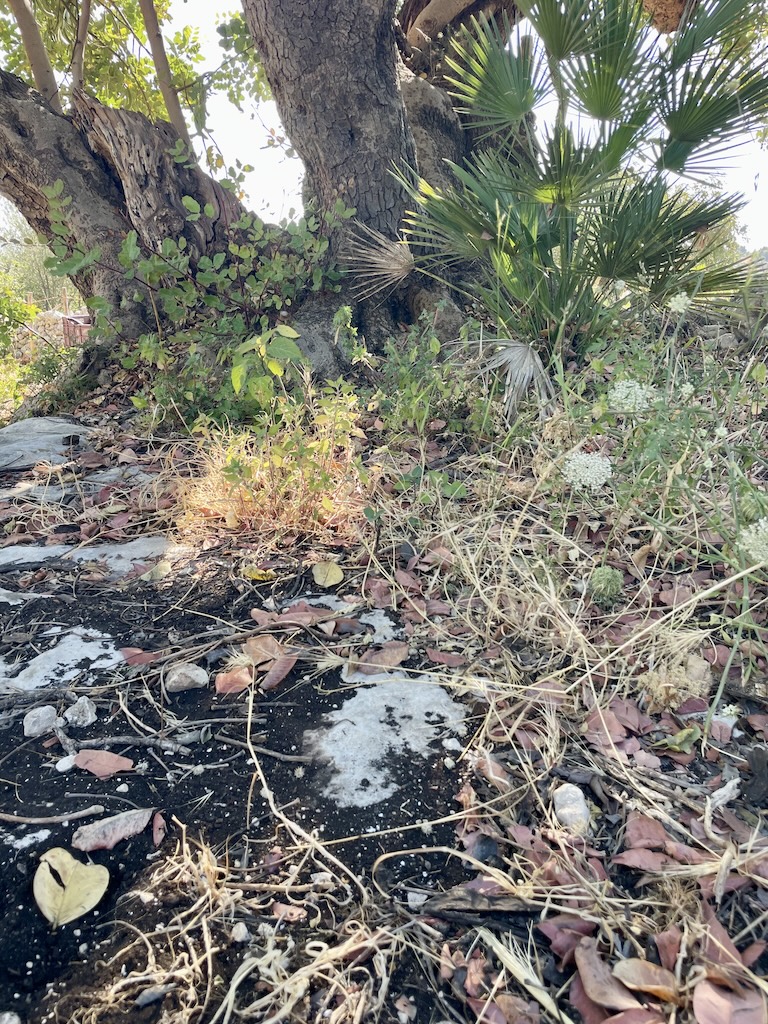
On the limestone plateau of the Monti Iblei — the geological backbone of southeastern Sicily — the carob has been doing this work for millennia. Its roots penetrate the calcareous rock through natural fissures, widen them slowly, and in doing so pull down organic matter, microorganisms, and structure. What remains, over time, is living soil: capable of retaining water, hosting fungi and bacteria, and sustaining the plants that come after.
At Three Farms Island, a regenerative farm in the Val di Noto countryside near Noto, this process is not theoretical. The land has never been treated with chemical products — which means the challenge is not to restore depleted soil, but to create soil where only rock exists. The carob trees already present on the land — some of them centuries old — are the primary agents of this process. They are not a crop. They are the foundation.
This is one of the most concrete expressions of regenerative agriculture: not recovering what was lost, but building what never existed.
Carob in Sicily: Not Chocolate, But Bread
The popular description of carob as il cioccolato dei poveri — the chocolate of the poor — is a modern simplification that misses the point. In Sicily, the carob was not a substitute for something else. It was a primary food in its own right.
The Sicilian saying is direct: when wheat is scarce, carob and water are enough to survive. Not merely endure — survive well. The pod is naturally sweet, genuinely satisfying, and nutritionally complete in a way that made it a staple rather than a substitute. For agricultural communities across the Monti Iblei plateau and the Val di Noto, the carob was the harvest that never fully failed: drought-resistant, storable, and available even in the years when wheat did not come.
Technically, the carob is a legume — not a fruit, not a tree crop in the conventional sense. Its pod contains a pulp rich in natural sugars, dietary fiber, calcium, and antioxidants, with no caffeine and no theobromine. What contemporary nutrition labels as a superfood, Sicilian farming communities understood as reliable nourishment long before the terminology existed.
The name used across northern European languages tells the same story from a different angle. In German, the carob is Johannisbrot — the bread of Saint John. The reference is biblical: John the Baptist in the desert, sustained by what scripture calls “locusts” — a term that in Hebrew and Syriac tradition refers not to insects but to carob pods. The tree’s association with sustenance, with the minimum necessary to continue, runs through Mediterranean cultures, religious texts, and everyday language in a way that no other cultivated plant in this region quite matches.
An evergreen leguminous tree that requires no irrigation, builds soil from bare rock, produces for four centuries, fed entire populations through their hardest years, and is now being rediscovered as a nutritional resource in contemporary food science. The carob did not need rediscovery. It never went anywhere. It was simply waiting, as it always has, for the rest of us to catch up.
Carob Molasses: A Rare Product of Traditional Sicilian Agriculture
Carob molasses (miele di carruba in Sicilian dialect) is produced by slow-cooking carob pods until the natural sugars concentrate into a dense, dark syrup. The result has the color of dark caramel, a consistency between honey and treacle, and a flavor that combines sweetness with a faint mineral undertone — something between chocolate and dried fig, without being quite either.
It is not easy to find. Industrial production of carob derivatives in Sicily has largely shifted toward carob flour and carob seed gum — both used as food additives in the global industry. Molasses, which requires slow traditional processing and does not scale efficiently, has almost disappeared from commercial distribution.
At Three Farms Island, carob molasses is produced from the farm’s own carob trees and served as part of the farm’s food experiences — on the table alongside bread, olive oil, seasonal fruit, and homemade marmalades. It is one of the few products of this land that carries the full history of the Sicilian countryside in a single taste.
Carob at Three Farms Island
The carob trees at Three Farms Island are part of an active reforestation project, planted alongside olive, almond, and pistachio trees — native Mediterranean species chosen not for immediate production but for their role in rebuilding the ecosystem over time.
But the carob here was also found, not only planted. On the surrounding Monti Iblei plateau, carob trees grow as they always have — spontaneous, ancient, unmanaged. When we began working this land, they were already here. A specimen of approximately 400 years stands on the plateau, rooted in rock, producing abundantly, indifferent to the passage of agricultural fashions and economic cycles. It has been here longer than the farm, longer than any plan. It will likely remain longer than any of us.
This is what regenerative agriculture looks like from the inside: not a methodology, but a relationship with time. The carob trees we found here taught us how to think about the land. The ones we planted are the answer we gave back.
Carob molasses from the farm’s own trees is served as part of the olive oil tasting and farm brunch experience and the farm-to-table food experience at Three Farms Island.