Almond Trees and the Sicilian Landscape
At our farm in southeastern Sicily, almond trees are grown without irrigation, following a tradition of dry farming shaped by the Mediterranean climate. Limestone soils, traditional varieties, deep-rooted trees and long, dry summers are all part of a relationship between almonds and this landscape that has developed over centuries.
There are plants that do not simply belong to a landscape.
They are the landscape.
They shape it through their presence, their forms and their colours, creating an almost symbiotic relationship between plant and place. Sometimes, all it takes is looking at the countryside to understand, almost instinctively, how deeply the two are connected.
In our part of southeastern Sicily, the almond tree is certainly one of those plants.
Together with olive and carob trees, it helps define this dry Mediterranean landscape of limestone soils, long summers, intense sunlight and very little water.
Its presence here has very ancient roots.
Sicily has always stood at the centre of Mediterranean exchange, and almonds were already among the plants and foods moving through the ancient world. The Phoenicians played an important role in their diffusion across the Mediterranean, followed by other peoples and cultures that crossed and settled on the island.
But beyond documented history, sometimes it is enough simply to observe the plant itself.
Seeing how easily an almond tree can take root and grow in our countryside gives us a sense of just how well this species found its place here, and how old the relationship between the almond tree, first in its more rustic forms and later through selected varieties, and the Sicilian landscape must be.
Our almond orchards are not irrigated.
This is not simply a farming choice.
It is the continuation of a much older relationship between the almond tree and this land.
Dry-Farmed Almonds in Sicily
Today, agriculture is often discussed in terms of irrigation: how much water a crop requires, how frequently it should be supplied, and how production can be increased through increasingly controlled growing conditions.
But for most of Sicily’s agricultural history, things worked very differently.
Today, drilling a well, pumping water from deep underground and distributing it through an irrigation system is technically relatively simple.
For farmers in the past, it was not.
They had to work with the water that was actually available.
This meant choosing crops not simply according to what people wanted to grow, but above all according to what the land itself was capable of sustaining.
Necessity became knowledge.
Generation after generation, farmers selected the plants that were best able to live in particular conditions, adapting to limited water, the nature of the soil and the long Mediterranean summers.
The almond tree has characteristics that make it particularly suited to these environments. It can develop a deep root system, with a strongly tap-rooted structure in its early stages, allowing it to explore deeper layers of soil in search of available moisture.
This is one of the reasons why it became such a familiar presence in the dry landscapes of the Mediterranean.
The almond tree became part of the Sicilian landscape because it was able to live within its conditions, not because those conditions were changed in order to make the tree survive.
Our almonds still follow this principle today.
We do not irrigate our almond orchards during the growing season.
The trees live according to the natural rhythm of rainfall, soil and seasons, developing within the limits of the landscape rather than trying to remove those limits artificially.
For us, this is an important distinction.
Farming within the limits of the land
Dry farming requires a different way of thinking about agriculture.
The aim is not simply to obtain the greatest possible quantity of fruit from each tree.
It means observing the soil, working with varieties suited to local conditions, leaving enough space between trees and accepting that every agricultural year will be different.
Rainfall matters.
Temperature matters.
The timing of spring matters, and so does the intensity of summer.
The harvest, therefore, can never be completely separated from the year that produced it.
Some years are generous. Others are more difficult.
This variability has always been part of Mediterranean agriculture.
Rather than trying to eliminate it completely, we work within it.
Traditional Almond Varieties and Local Adaptation
To speak about old varieties in Sicily also means speaking about the history of the island.
Sicily has always been a land of passage, encounters and exchange.
Peoples, plants, farming techniques and food traditions arrived here over the centuries. But they did not simply accumulate one on top of another.
They met and, above all, they adapted.
We sometimes tend to think of people and the environment as two separate things.
In reality, they are part of the same ecosystem.
Even the agricultural varieties that we now consider traditional are the result of this relationship.
A plant arrives in a territory. It encounters a particular soil, a certain amount of rainfall, a longer or shorter summer, the wind, the temperatures. And it also encounters people, who observe it, cultivate it, propagate it and, generation after generation, choose the plants that respond best to those conditions.
Over time, farmers selected almond trees not only for the characteristics of the almonds they produced, but also for their ability to live in this environment.
Which ones could better withstand dry summers.
Which ones responded better to irregular rainfall.
Which ones could produce well without requiring conditions the land could not naturally provide.
The selection of varieties, therefore, was never simply a botanical matter.
It was the result of a long relationship between environment, agriculture and culture.
This is also why traditional varieties matter to us.
They carry agricultural memory.
They tell not only the story of a plant, but also the story of the people who learned how to cultivate it in this landscape.
Our approach tries to continue that relationship: choosing plants and farming practices that are compatible with our land, rather than continually altering the land to meet the requirements of production.
Limestone soil, sun, wind and time
The countryside of southeastern Sicily is strongly shaped by its limestone geology.
The soils are often relatively shallow, water is limited during the long summer months, and sunlight is abundant.
From time to time, something also arrives from much farther away.
Mount Etna lies around eighty kilometres from us, and during some eruptions, under particular wind conditions, its very fine volcanic ash can travel as far as our countryside.
It is an occasional, almost imperceptible presence, and a reminder that even landscapes that seem distant from one another are, in reality, connected.
Over time, these volcanic materials also become part of the complexity of our soils, together with the limestone base that characterises this area.
For many crops, these conditions can be difficult.
For almond trees, as for olive and carob trees, they are part of an environment to which these plants have adapted over time.
The almond tree moves slowly through the seasons.
Flowering comes very early, when winter is not yet completely over.
The fruit develops throughout spring and then faces the driest months of summer.
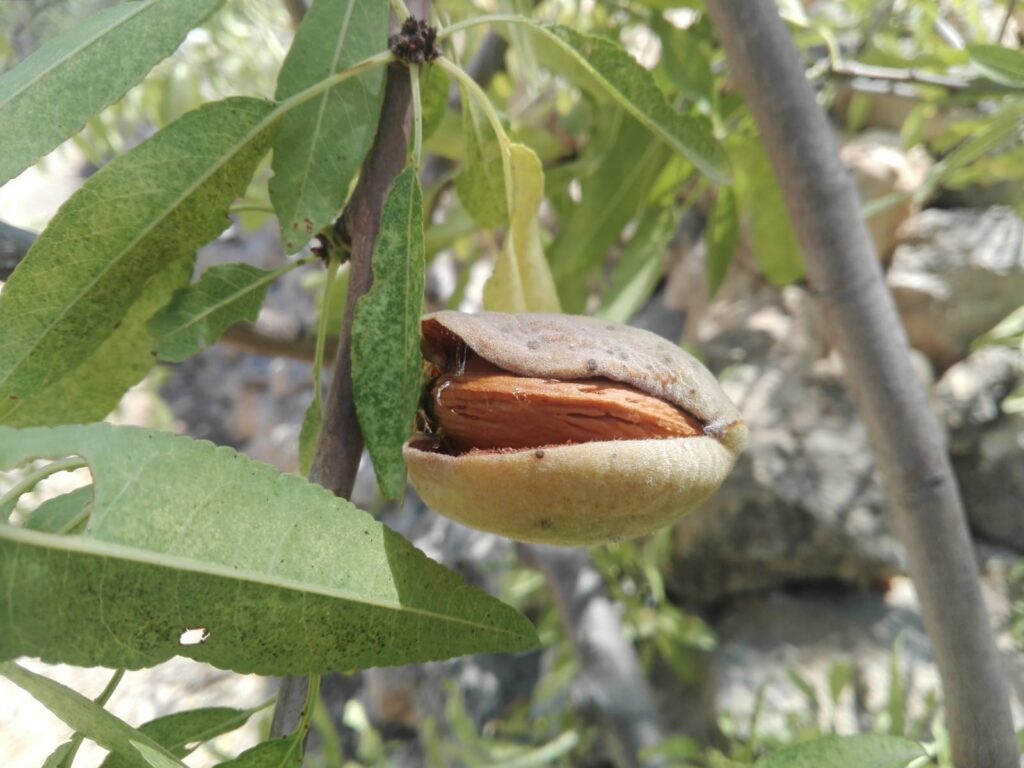
By harvest time, the almond is the result of an entire season lived almost completely without added water.
And even after it has been harvested, the process is not yet finished.
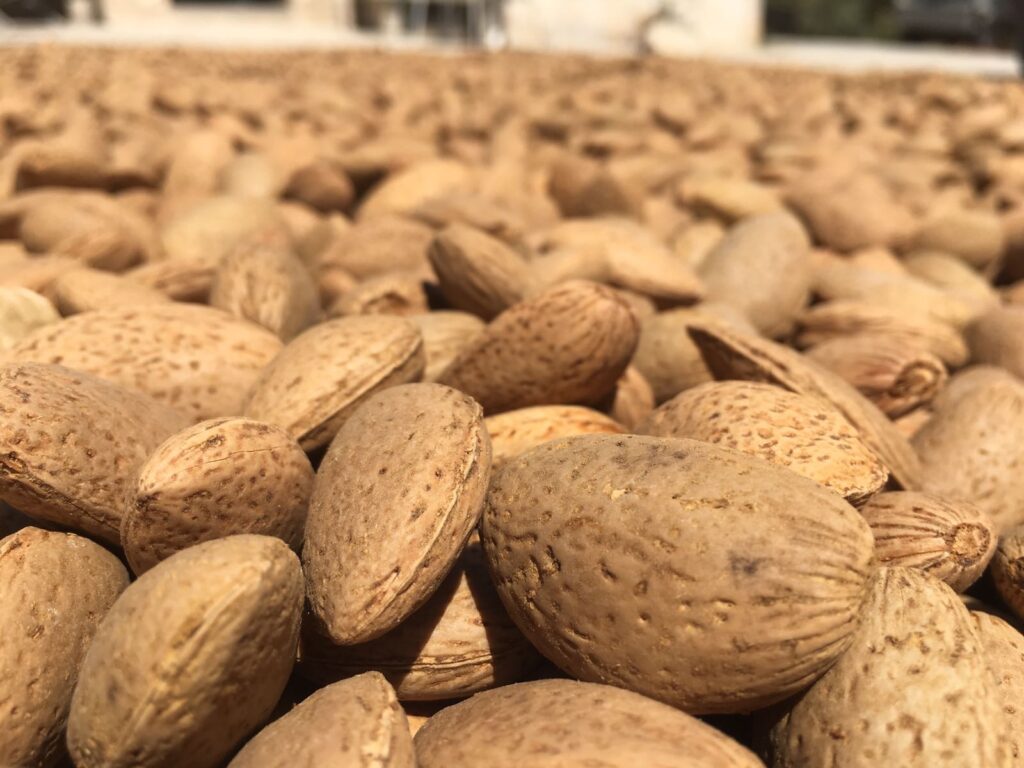
How We Dry Almonds After Harvest
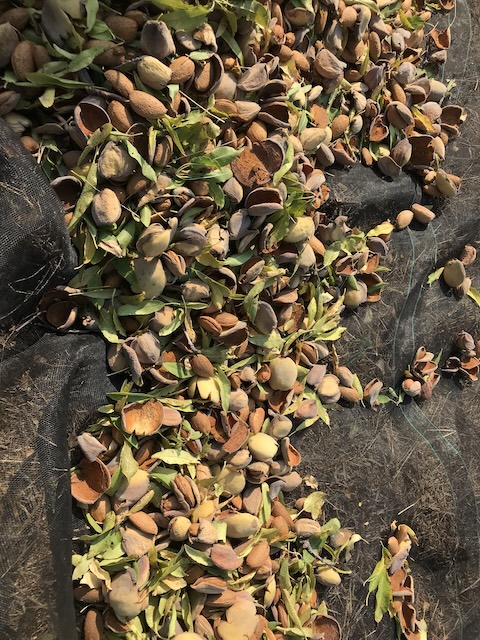
After harvesting, we spread the almonds outside and leave them under the late-summer sun.
It is not simply a beautiful image marking the end of the harvest.
It is a precise part of the process.
The warmth of the sun and the dry air continue the work that began on the tree, naturally reducing the remaining moisture and helping the kernel separate more cleanly from the shell.
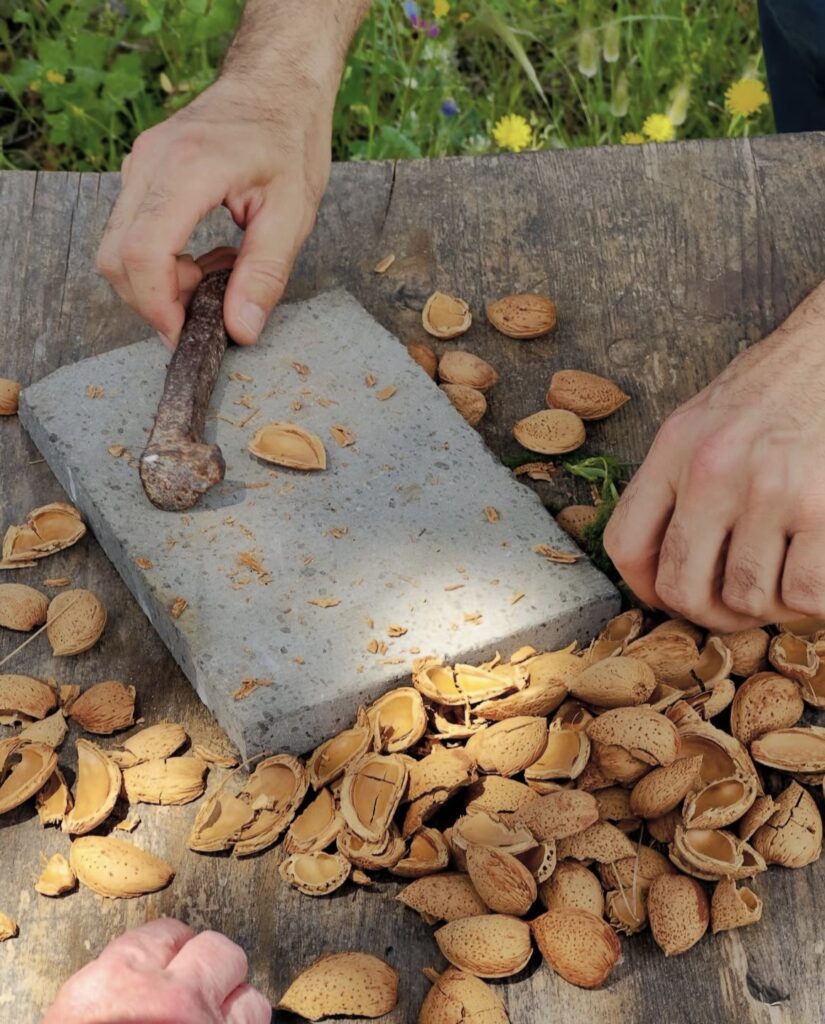
This makes it easier to remove the almond when the shells are eventually cracked.
This stage follows the same logic as the way we grow them.
Water, sunlight, air and time are not elements we try to replace: they are part of the process.
Our almonds reach harvest after a completely dry growing season and continue to dry naturally under the sun.
This allows us to keep their processing simple and minimally invasive, preserving as much as possible of their aromas, their naturally occurring oils and their organoleptic qualities.
Harvesting, therefore, is not the end of the process.
Sun, air and time still have something to do.
Almonds in Traditional Sicilian Food
To understand how deeply almonds belong to Sicily, we only need to look at our food.
Their presence here is not recent, and it certainly did not begin with the modern interest in plant-based drinks or ingredients associated with contemporary healthy eating.
Almonds have been used in Sicily for centuries, in countless different forms.
One of the simplest examples is almond milk.
[How we make almond milk → LINK]
Today, it is often seen as a modern alternative to dairy milk.
In Sicilian food culture, however, its use has much deeper roots.
This too can be understood through the landscape.
During the driest summer months, when the fields almost completely stop producing fresh grass, animal feeding changes as well, and historically the availability of fresh milk could decrease.
The kitchen therefore found other solutions, using what the land could provide.
Almonds had one great advantage: they could be stored for a long time and transformed whenever needed.
But almond milk is only one example.
Almonds run through much of our culinary tradition: from pastries and biscuits to granita and creams, as well as savoury preparations.
We also find them in recipes such as Sicilian pesto, where almonds meet other Mediterranean ingredients and become part of a cuisine built, once again, around what grows in the surrounding landscape.
[Our Sicilian pesto recipe → LINK]
There are countless recipes because, for a very long time, almonds were not simply a special ingredient.
They were a resource.
A food that was available, nutritious, easy to store and deeply connected to the agriculture of the island.
The recipes came later.
The ingredient was already here.
The almonds from our farm
We have always enjoyed sharing our almonds with the people who come to visit us.
Tasting an almond in the place where it was grown creates a very simple connection between food and landscape.
Our younger almond orchard is now beginning to produce and, as the trees mature, our harvests will gradually increase.
Perhaps, in time, this will also allow us to share our almonds with people who cannot come directly to the farm.
But the principle behind the way we grow them will remain the same.
Almond trees grown without irrigation, varieties suited to local conditions, simple processing, and an approach to agriculture that tries to work with the land rather than force it.
For us, this is where the quality of an ingredient begins.
Not with the recipe.
With the soil, the tree, the season and the way it was grown.